


09 Mar What I love about the OM SYSTEM cameras
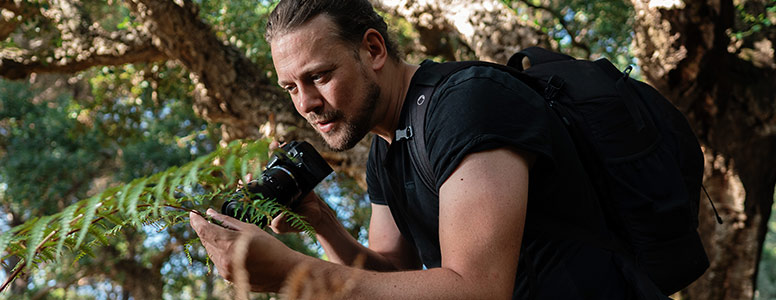
For my personal approach to macro photography at high magnifications, the OM SYSTEM cameras are my preferred tools, but WHY do I actually LOVE them?
I have been shooting with 3 generations of OM SYSTEM (formerly Olympus) cameras now – coming from a Canon full-frame setup.
It has always been my intention, to share my experiences with the different camera systems in the most transparent way, to provide feedback for those, who face the same questions I faced, when I was comparing different options to improve my macro photography.
Aside from the macro photopgraphy features, the OM SYSTEM cameras have a handful of features I have really grown to love and I want to share those, as some are not the most promiment ones.
Some are beneficial for wildlife and macro photography outdoors, while others come in handy in other photographic fields – they all make up a great total package!
The road to Olympus / OM SYSTEM
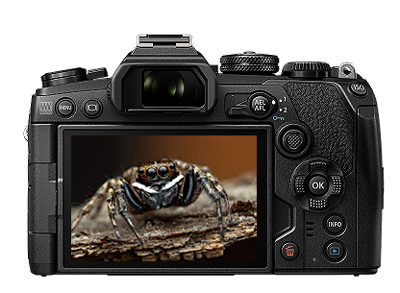
When I started with macro photography, I was already doing portraits, weddings and business photography for years.
Having started on a Canon crop Sensor, I ended up falling in love with full frame and even used this setup for macro for years.
However, the more I experimented and the closer I tried to get to my subjects, the more I realized where the full frame format held me back.
My favorite lens back then, the legendary Mp-E 65, was super heavy and hard to control with a paper thin depth of field on the 5D II´s full frame sensor.
I started to look into the pros and cons of the different sensor formats and brands and ultimately switched system and went for the Olympus micro four thirds format.
Here, I found a system that combined incredibly many features for macro (and also wildlife in general) photography.
The camera setup was compact, versatile, weather sealed, stabilized, offered a 2x sensor crop and had dedicated macro lenses beyond 1:1 magnifiication.
And I am not even mentioning the computational photography features.
The macro capabilities of OM SYSTEM cameras
No surprise – the macro capabilities of the OM SYSTEM cameras are, what have motivated me to switch from Canon full frame to OM´s Micro-Four-Thirds system.
Just to quickly name the most important ones, since you can read a lot more about them in my other articles.
MFT sensor
The MFT sensor features a 2x crop, which leads to images with a narrower (double) field of view, if compared to a full frame sensor.
While this is no real extra magnification, the actual sector you can see on the MFT image is a crop of a theoretical larger image (or sensor) and hence appears to have a higher magnification. With only a 1:1 macro lens on the MFT sensor, the image shows the exact same sector as if taken with a 2:1 macro lens on a full frame sensor.
Macro lenses
OM SYSTEM´s macro lenses cover a good range, especially for high magnification macro work.
While the M.Zuiko 60mm f2.8 Macro is the standard macro lens, offering 1:1 true macro magnification (comparable to 2:1 on a full frame sensor) and being super compact and light, there is also the M.Zuiko 30mm f3.5 Macro for a wider field of view with an impressive 1.25:1 magnification.
With an extreme magnification of 2:1, the M.Zuiko 90mm f3.5 Macro IS PRO produces tack sharp images that are equivalent of 4:1 on a full frame sensor, hence is getting you very close and reveals details that are usually hidden from the naked eye.
Adding the MC-20 2x Teleconverter, enables the 90mm to get to 4:1 (8:1 equivalent)
Even the relatively new M.Zuiko 50-200 IS PRO can reach an impressive 1:1 magnification when paired with the 2x Teleconverter.
Wide-angle zooms like the M.Zuiko 12-40mm f2.8 PRO and 12-45mm f4 PRO (and others as well) have such a short minimum focusing distance, that you can take wide-angle macro photos with them, given the subjects are not too small.
Third-party brands, like LAOWA, also offer dedicated macro lenses with MFT mount.
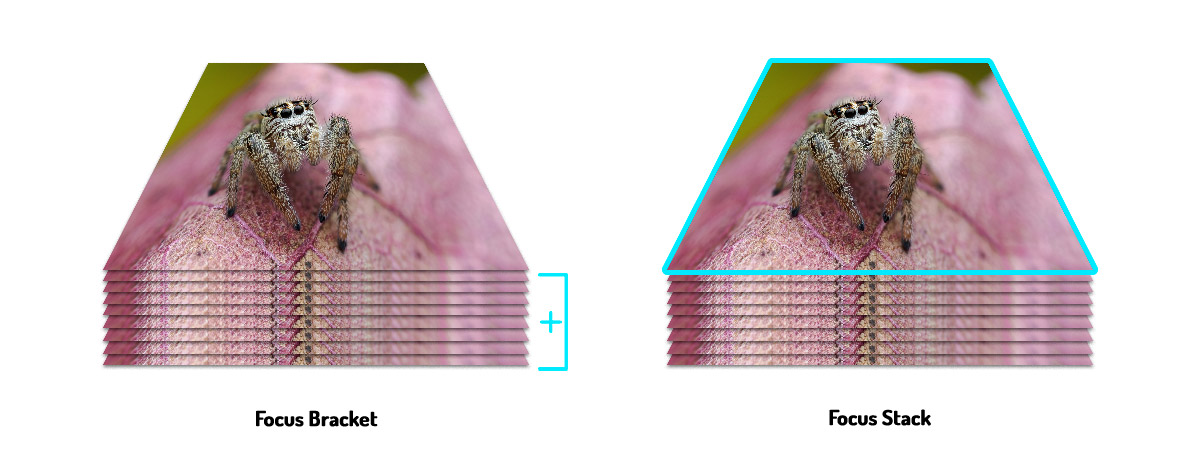
Automated Focus Bracketing and Focus Stacking
At higher magnifications depth of field gets extremely shallow.
To capture an image with a subject or specific details in focus, a technique called focus stacking can be used.
A stack of images is captured, where the thin layer of cocus is shifted across the subject (like scanning) and then combined in post-process to create a final image composite with a deeper in-focus plane.
While this can be done manually, for example by moving the camera back/forth between each shot, the OM SYSTEM cameras can do this fully automated.
It can both create the base stack of shifted-focus images (focus bracketing) and also merge them in-camera into the final composite image (focus stacking), if you want.
Not only is this considerably faster than manually creating the sequence but it is also more precise and cut down your post-processing time noticeably.
The hidden game changers for me
Aside from the aforementioned more obvious features for macro photography, there are some lesser advertised features, that I really love.
No more sensor dust – ever: the Supersonic Wave Filter on the sensor
If you are photographing outdoors and change lenses frequently, you have probably experienced this as well (depending on your camera system obviously):
Dust and particles are sticking to the sensor and need to be removed from time to time by cleaning the sensor during service.
In macro photography you will see particles show in the photo, which you would not even notice if you used a lower magnification, for a standard portrait shot of a face for example.
At high magnifications though, all these little sensor dust spots will show and require you to clean them in post.
This can be very annoying.
Do not get me started with focus stacks…
On my DSLR full frame setup, I have spent more time cleaning sensor dust in post, than I was actually photographing in the field.
It was the worst, when I went to sandy beaches or overly dry and dusty habitats.
The photo below (straight-out-of-cam jpg) is one of the manageable examples, I had photos with 3 times the spots, which means an annoyingly lot of retouching especially for focus stacks.

Visiting the photo store and lab regularly after my travels and field trips was mandatory.
Here´s what I love about my OM SYSTEM cameras: I have never been to get my cameras´s sensors cleaned ever.
And I have used them for years now and change lenses in the field as well – often under challenging conditions.
Not one single particle of sensor dust has ever shown in any photo so far.
Why is that?
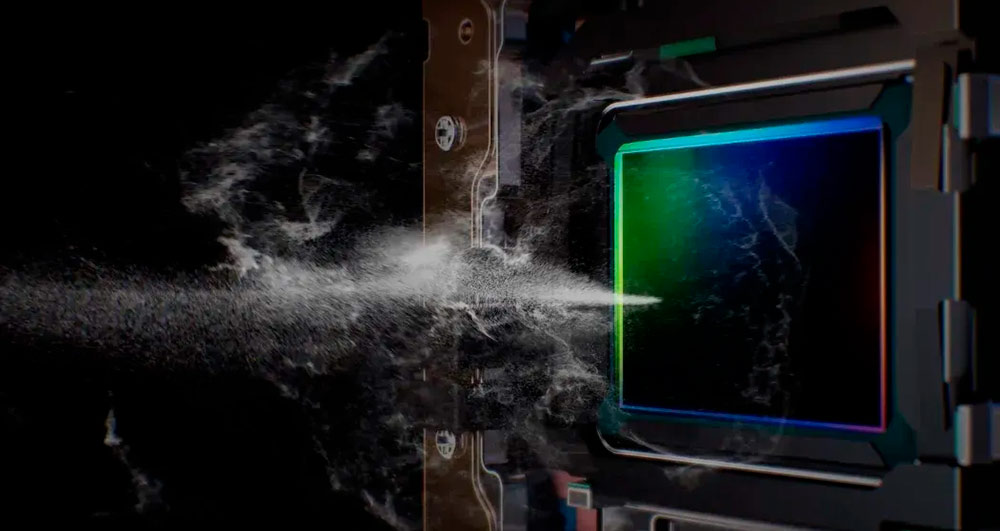
OM SYSTEM call its very own dust reduction system the Supersonic Wave Filter, which is placed between the sensor and shutter.
Whenever you power the camera on or off, It vibrates at 30,000 times per second and shakes off all particles effectively.
I have rarely been impressed this much by an advertised feature of a camera system.
It really works and I can not imagine not having this feature anymore – even more so, considering I am doing outdoor photography, being prone to dust and dirt getting in contact with my camera.
Compact and light
In comparison to larger sensor setups, may it be crop DSLRs, full frame or even some mirrorless cameras, the MFT system allows for both very compact bodies and lenses.
This is a great advantage for travelling, as well as for carrying and using the cameras in the field.
In macro photography, this also means it will be easier to single handhold the camera and have the other one free to support with whatever.
A smaller setup also allows me to move more effectively in the foliage and reach obstructed specimens.
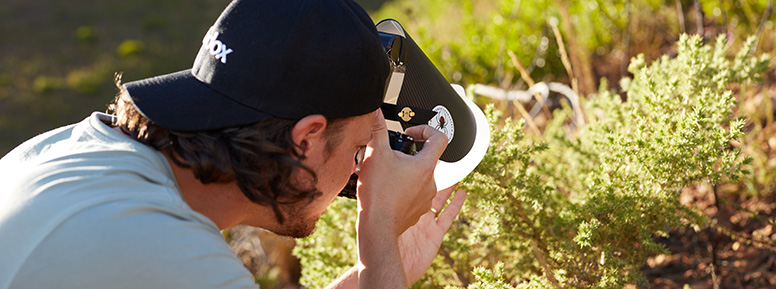
Even with an additonal flash and diffuser attached to the camera, it still remains a compact system while being easily operatable one-handed.
Incredible stabilization
Not really a hidden feature, but one that is so incredible, that I have to mention it.
The 8.5 EV stops of the 5-axis in-body stabilization (of the OM-1 Mark II) open up so many new ways of how I photograph, that I do not want to miss it anymore.
Not only does the stabilization help in various scenarios for macro photography, it is even more effective when I do traditional photography, like portraits and people.
The OM SYSTEM IS has increased my handheld-shooting hit-rate considerably: even in low light conditions, I am able to use extremely slow shutter speeds and still get great and sharp photos.

For macro photography, the IS enables me to incorporate ambient light more effectively into my shots, especially the wide angle macros, where I show more of the habitat.
If I find subjects, where a flash won´t work, the IS lets me work with the remaining light.
Often specimens are sitting in places, where optimal lighting is scarce.
While not a frequent scenario, photographing under UV light is another example where a flash cannot be used and the image stabilization is very helpful to produce sharp shots during the night, with the fluorescent subject being the only illuminated part of the image.
Weather resistance
The OM SYSTEM camera bodies, and also many of their lenses (the PRO ones and selected others), are made for the outdoors.
They can withstand rain, sand and extreme temperatures – which make them a great choice for all sorts of expeditions and challenging scenarios.
In combination with the above mentioned super sonic wave filter, they are a workhorse for my photography, even under subpar conditions.
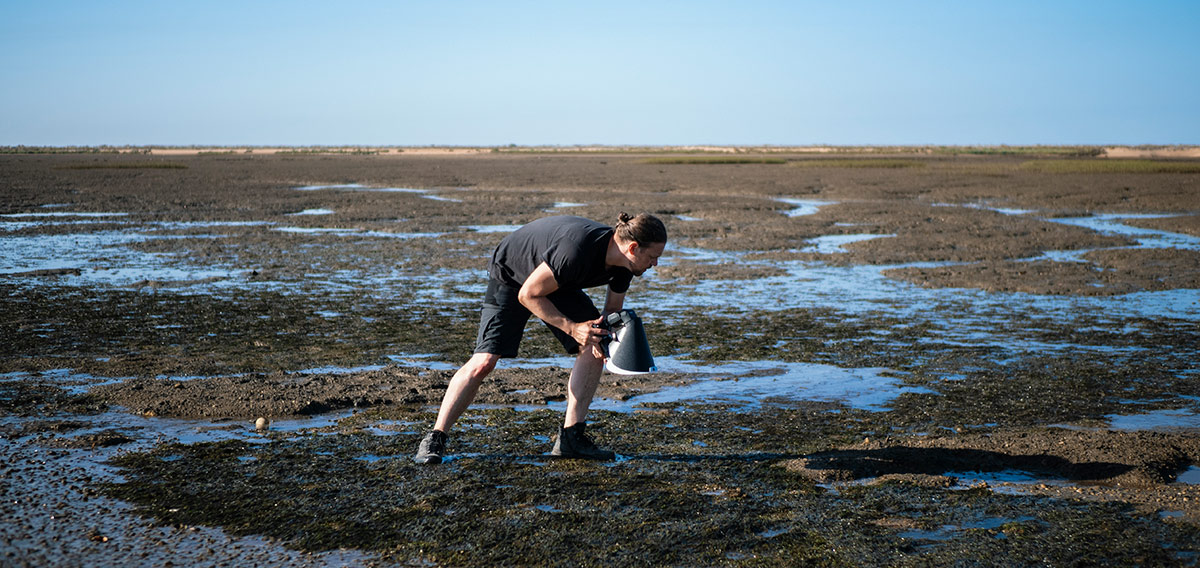
I have used my setups in the mud, during rain, in sandy beach dunes with the wind blowing and on the beach, lying in the mud photographing crabs.
It has never let me down so far.
The swiss army knife of outdoor cameras
As you have seen, there are a lot of features, which make up a great overall camera.
Do I need all of them?
Probably not…
Is it great to have them all on board and ready to use IF and WHEN I need them?
Absolutely!
That´s why I use to call the OM SYSTEM cameras the “Swiss Army Knives” of cameras.
Their new bodies and also many lenses are weatherproof as well!
Imagine this: I go on an early morning macro field tour.
After photographing some focus stacks of slow insects in the early morning with my specialised macro setup, consisting of OM-1 II, M.Zuiko 90mm IS PRO macro, flash and macro flash diffuser, I realize the rising sun creates beautiful lighting on the mountains in the backdrop.
Unfortunately the brighter, colorful sky creates a high contrast to the fields around me, that are still untouched by the morning sun.
With the built-in live GND filter I darken the sky a bit and get a perfectly exposed photo.
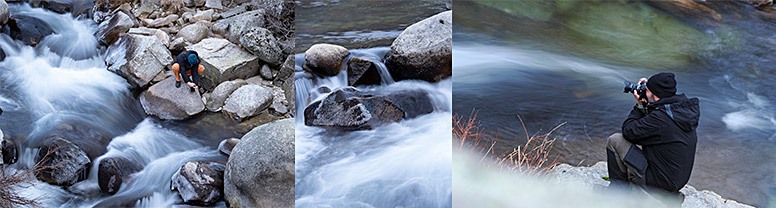
While I am at it, I notice a small waterfall close by and decide I will photograph this one later as well, on my way back.
The built-in live ND filter allows me to slow down the water considerably, transforming the wild waterfall into a creamy, out of focus stream.
No additional filters needed, as I have all of those right with me in-camera, thanks to the computational features.
Computational photography features (depending on body model)
- multi-shot high-resolution modes (handheld up to 50MP, on tripod up to 80MP)
- live ND filter (ND128)
- live GND filter (GND2+4+8)
- live composite
- ProCapture buffers images pre-shutter (insanely good for birds)
- HDR
- in-camera focus stacking and focus bracketing
- AI-based subject and eyes detection (including birds, animals, and humans) and selection
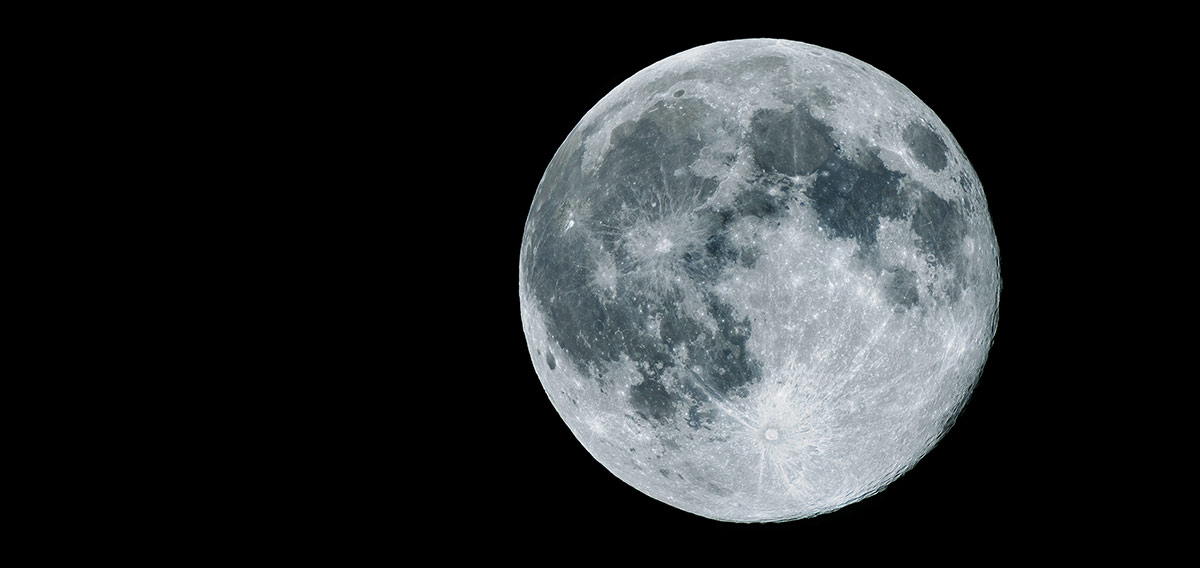
- Starry sky AF to autofocus on stars for astrophotography
Conclusion
First and foremost I choose a camera system for its features as a tool to help me capture the photos I want.
100% free of emotion, I go for the solution that brings the best benefits and has the most features packed.
This led me to OM SYSTEM, after having photographed with Canon DSLR crop and full frame sensors for years.
With OM SYSTEM I was able to capture better photos and be more time efficient, all this while carrying less weight and having a reliable weather restistance on my gear.
In addition I have always liked the design and look of the cameras and lenses.
With being fascinated by the effectiveness of my new setup, also came passion and love for the brand.
And it kept and keeps growing.
If OM SYSTEM manages to tick some points off my list of improvment recommendations with the next models, an already awesome camera system will be even better!
For wildlife macro photography, at high magnifications in particular, the OM SYSTEM is the best choice and an impressive tool.
If you are thinking about switching systems and have questions, feel free to comment or send me an email directly.
Before buying an OM SYSTEM setup, always make sure to drop me a message for a special discount for the best price available.
You might also be interested in checking out these blogpost that also directly or indirectly cover the same topic (in german though, please use translate browserplugins):
Sign up for the newsletter mailing list & free ebook

Did you enjoy these tips and want to learn more or improve your macro photography skills?
Stay up to date with new blog posts, reviews and tutorial- and ebook-releases.
Sign up below to get notified when the free edition of my ebook
‘How to master spider & insect macro photography’ is ready for download.
No Comments